The Renaissance marked a paradigm shift in how artists perceived and represented the world. The mastery of perspective, anatomy, and light didn't emerge from abstract theory alone, but from meticulous observation and rigorous mathematical principle. This essay explores the foundational techniques that transformed painting from medieval convention to Renaissance innovation.
The Foundation: Linear Perspective
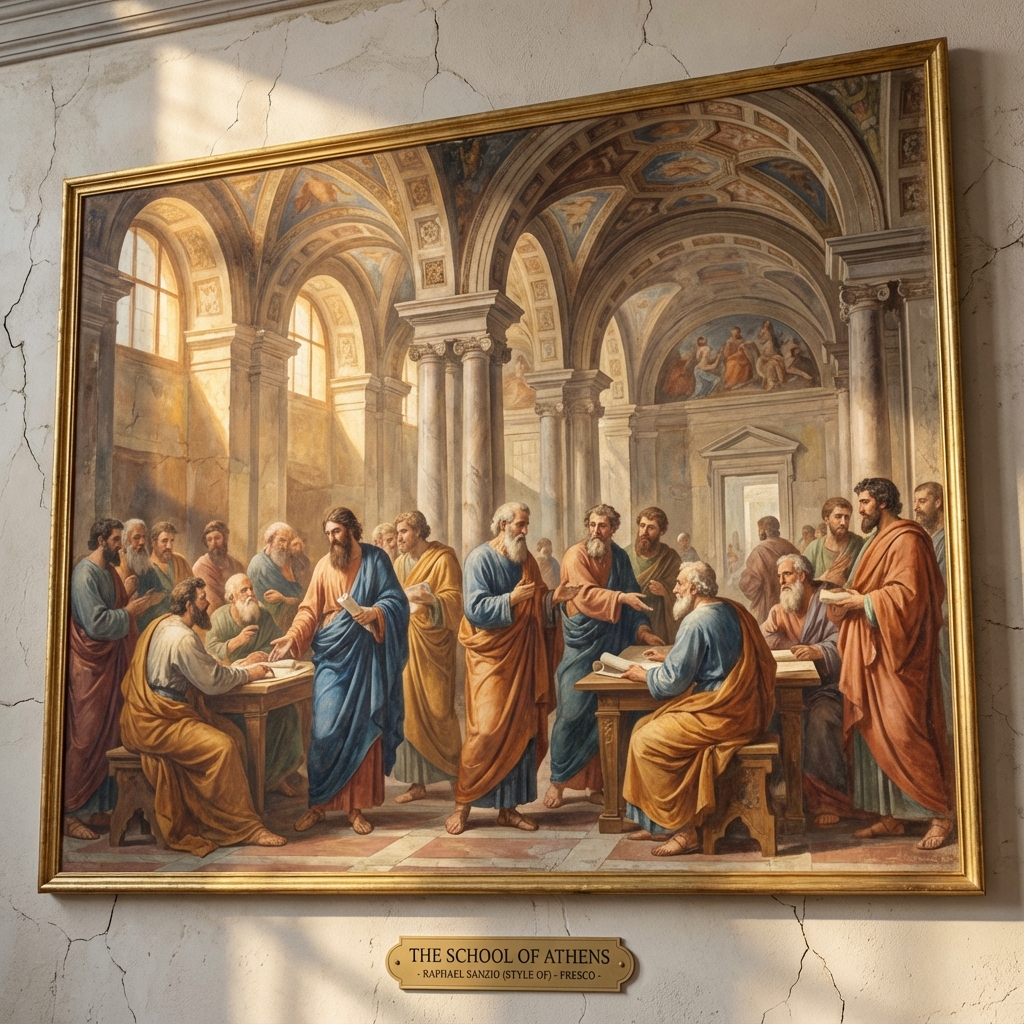
Linear perspective, developed most rigorously by Filippo Brunelleschi and theorized by Leon Battista Alberti, represented a revolutionary departure from medieval artistic conventions. This mathematical system created the illusion of three-dimensional depth on a flat surface by converging orthogonal lines toward a vanishing point.
"Perspective is nothing more than seeing a place behind a pane of glass, smooth and transparent, on which the objects behind that glass are drawn." — Leon Battista Alberti
Mastery Through Practice: The Workshop System
The Renaissance workshop system was the engine of artistic development. Young apprentices, often starting as children, spent years grinding pigments, preparing panels, and copying master works before advancing to more complex tasks. This hierarchical training ensured consistency in technique while allowing for individual innovation.
Raphael's workshop in Rome became legendary for its efficiency and quality. Artists worked collaboratively, with the master designing compositions while assistants executed portions based on their skill level. This system produced some of history's most celebrated frescoes and altarpieces.
Color, Light, and Atmosphere
The development of oil paint technology, perfected by Flemish masters like Jan van Eyck, revolutionized how artists could achieve depth through atmospheric perspective. By layering thin glazes of translucent color, painters could create an illusion of aerial perspective—distant objects appearing softer and more blue-toned.
Leonardo da Vinci's concept of sfumato—literally "smoking"—took this further, creating subtle transitions between tones without harsh lines. The Mona Lisa's enigmatic quality emerges partly from this technique, where soft edges and atmospheric haze create psychological ambiguity.
Historical Context
The Quattrocento (15th century) witnessed an explosion of artistic innovation. Patronage from wealthy merchant families like the Medici provided the financial stability that allowed artists to experiment and perfect new techniques. The fall of Constantinople in 1453 brought Byzantine scholars and manuscripts to Italy, enriching intellectual discourse.
The Anatomy Revolution
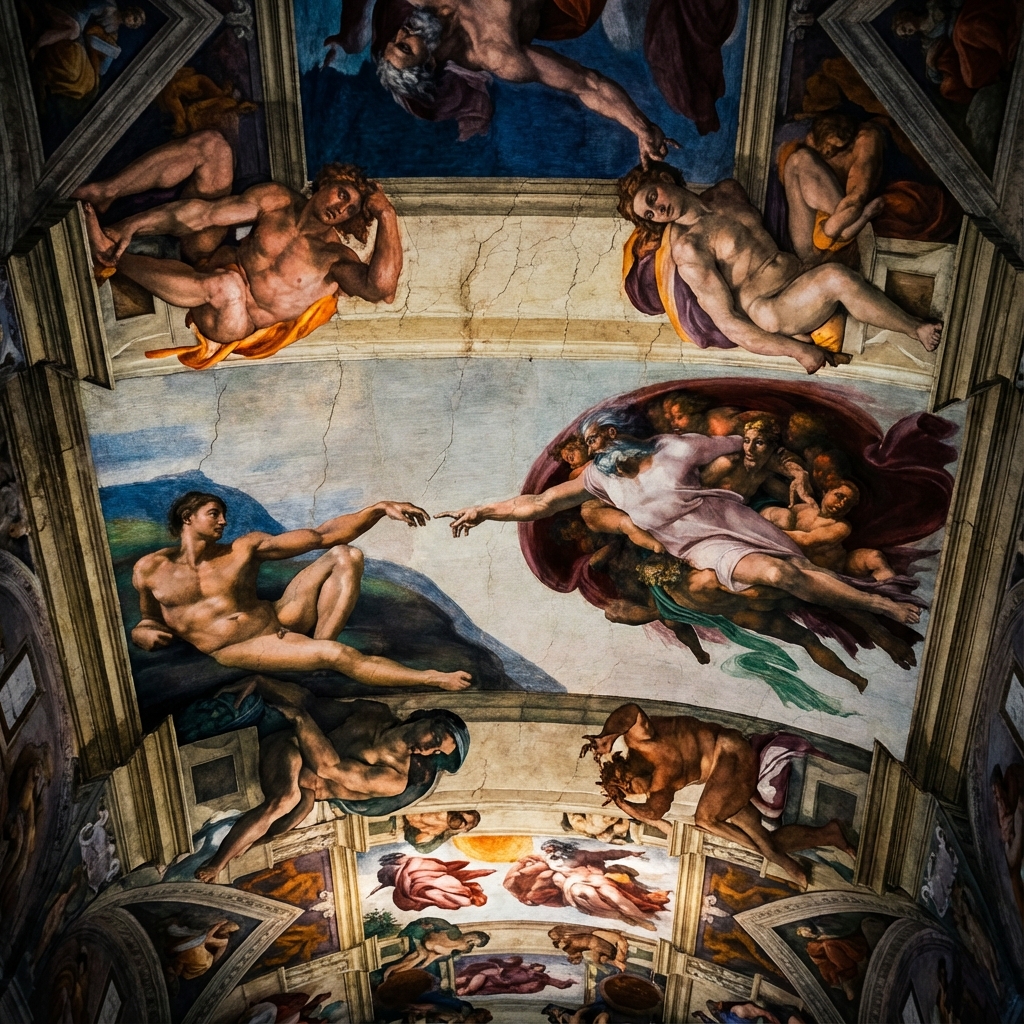
Michelangelo's obsessive study of human anatomy—gleaned partly from dissections—elevated figure drawing to an art form. His representations of muscle, tension, and movement created a new standard for depicting the human form. The contraposto stance, perfected during the Renaissance, gave figures a dynamic, life-like quality that medieval and Early Renaissance works lacked.
This anatomical precision wasn't merely decorative. It conveyed meaning—the strain of muscles showed effort and emotion, while proportional relationships communicated hierarchical importance in religious compositions.
Conclusion: Art as Intellectual Pursuit
The Renaissance transformed painting from craft to intellectual pursuit. Artists were no longer mere artisans but learned professionals who studied mathematics, anatomy, optics, and philosophy. This synthesis of technical mastery and intellectual rigor produced works of unprecedented depth and sophistication.
The secrets of Renaissance painting weren't magic—they were the fruits of systematic observation, mathematical precision, and tireless practice. Understanding these techniques allows us to appreciate not just the beauty of these works, but the genius behind them.